
|
BBN Internet Engineering Timeline
On October 15, 1948, Richard Bolt and Leo Beranek formed a partnership to do consulting in acoustics. Quite soon they hired Robert Newman and in 1950 the partnership was renamed Bolt Beranek and Newman. Since that time the organization has had a number of formal names but has always been referred to as BBN.
JCR Licklider was recruited by Beranek starting in 1956 and joined the firm in spring 1957. Within a few months Lick had persuaded the company to purchase a digital computer to be used for research, and shortly thereafter BBN was seeking computer research and development contracts which eventually became a mainstay of the firm. As an R&D contractor to the US government, BBN was heavily involved in engineering the new communication technologies which grew into the Internet.
The Internet, of course, is the result of the collaborative work of hundreds of organizations and thousands of individuals. Many of them have told their own stories, and the work of many more has been chronicled by others. What we have done here is to tell the BBN portion of the story, ignoring, but without meaning to denigrate, the contributions of others.
The timeline below has been created by the volunteer effort of former BBN employees. Some members of the BBN staff have been invited to comment on the result, but this is in no way an “official” publication of any of the organizations called BBN, and the authors take full responsibility for both the style and the accuracy of the result. Suggestions for improvements to the timeline should be sent to Harry Forsdick (harry at forsdick dot com) and Alex McKenzie (amckenzie3 at yahoo dot com).
The update history of this timeline can be found at Update History
JCR Licklider was recruited by Beranek starting in 1956 and joined the firm in spring 1957. Within a few months Lick had persuaded the company to purchase a digital computer to be used for research, and shortly thereafter BBN was seeking computer research and development contracts which eventually became a mainstay of the firm. As an R&D contractor to the US government, BBN was heavily involved in engineering the new communication technologies which grew into the Internet.
The Internet, of course, is the result of the collaborative work of hundreds of organizations and thousands of individuals. Many of them have told their own stories, and the work of many more has been chronicled by others. What we have done here is to tell the BBN portion of the story, ignoring, but without meaning to denigrate, the contributions of others.
The timeline below has been created by the volunteer effort of former BBN employees. Some members of the BBN staff have been invited to comment on the result, but this is in no way an “official” publication of any of the organizations called BBN, and the authors take full responsibility for both the style and the accuracy of the result. Suggestions for improvements to the timeline should be sent to Harry Forsdick (harry at forsdick dot com) and Alex McKenzie (amckenzie3 at yahoo dot com).
The update history of this timeline can be found at Update History
Text Timeline1967-68
Bob Kahn writes a series of BBN-internal memos about networking which are forwarded to Larry Roberts at ARPA
1968/8/9
BBN receives ARPA RFQ for a 4-IMP test network
1968/9/9
Bid submitted to ARPA, written by a team of Frank Heart, Bob Kahn, Severo Ornstein, Dave Walden, Hawley Rising, Bob Jacobson, and reviewed by Jerry Elkind, Danny Bobrow, Joe Markowitz, Will Crowther and others
1968/12
BBN awarded ARPAnet contract
|
Interactive Graphical Timeline
|
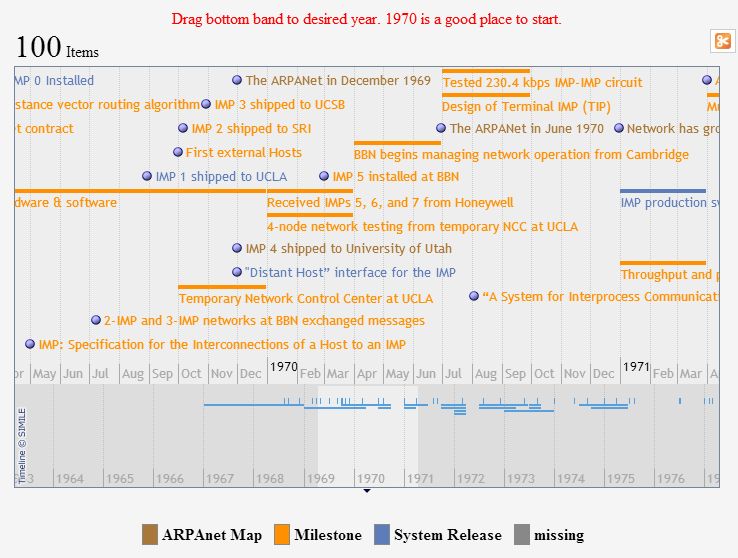
1969
Test network and IMP hardware and software developed by a team led by Frank Heart consisting of Ben Barker, Bernie Cosell,Will Crowther, Jim Geisman, Bob Kahn, Severo Ornstein, Truitt Thatch, Marty Thrope, and Dave Walden [See notes 4, 5, 15]
1969/3
IMP distance vector routing algorithm (dynamic adaptive routing) design completed [BBN Report 1783, pp 10-14]
1969/4
IMP 0 (standard 516, not ruggedized) received from Honeywell, 1 modem and 1 Host interface [BBN Report 1837, pg 1]
1969/5/1
BBN publishes BBN Report No. 1822, Specifications for the Interconnection of a Host and an IMP [BBN Report 1837, pg 1]. This document was an implementation guide for Host hardware and software. It was published in loose leaf form and revised several times as the interface changed or was expanded. The January 1976 version can be found at BBN1822_Jan1976.pdf
1969/7-8
2-IMP and 3-IMP networks at BBN exchanged messages sent between the Teletype “Fake” Hosts, exercising all the store-and-forward packet processing software [BBN Report 1890, pp 2-3] [See notes 4, 9, 31]
1969/8/30
IMP 1 shipped to UCLA. After installation IMP connected to Sigma 7 Host. Host and IMP exchange messages [BBN Report 1890, pg 4] [See notes 4, 9]
1969/10/6
IMP 2 shipped to SRI. After installation first long-distance message sent between the UCLA and SRI IMP “Fake Hosts” [BBN Report 1928, pg 1] [See notes 1, 2, 4, 9, 31]
1969/10
First external Hosts (UCLA Sigma 7 & SRI PDP-10) interactions via IMP subnet. Subnet performs according to spec. [See notes 4, 9, 31]
1969/10/30
IMP 3 shipped to UCSB [BBN Report 1928, pg 2]
1969/12/1
IMP 4 shipped to University of Utah. After installation the initial contract is complete (but is extended for an additional 15 IMPs) [BBN Report 1928, pg 2]
1969/12
Completed development of the “distant host” interface for the IMP, increasing the IMP-Host maximum distance from 30 feet to 2000 feet. ARPA realized after contract award that many organizations had multiple Hosts which were not physically adjacent. [BBN Report 1928, pg 6]
1969 Q4
Established a temporary Network Control Center at UCLA to coordinate network operation, debugging, and maintenance for the 4-IMP network. [BBN Report 1928, pg 2]
1970 Q1
Received IMPs 5, 6, and 7 from Honeywell. [BBN Report 1966, pg 4]
1970 Q1
Bob Kahn and Dave Walden conducted 4-node network testing from temporary NCC at UCLA. [BBN Report 1966, pp 7-9] [See note 19]
1970/3
IMP 5 installed at BBN, connected to UCLA by ARPAnet's first transcontinental circuit. [BBN Report 1966, pg 4]
1970 Q2
BBN begins managing network operation from Cambridge, including outage reporting to AT&T (all IMP-to-IMP circuits) and Honeywell (all IMP hardware) [BBN Report 2003, pp 11-12] [See note 10]
1970 Q2
Network expanded to MIT (#6), RAND Corporation (#7) and SDC (#8). [BBN Report 2003, pg 1]
1970/6/15
1970/8/3
Dave Walden publishes “A System for Interprocess Communication in a Resource Sharing Computer Network”; a protocol based on message exchange (rather than a connection-oriented protocol). [RFC 62]
1970/9
Dave Walden begins a 1-year effort at Norsk Data Electronikk (Oslo, Norway) to develop a small ARPANET copy on Norsk Data computers
1970 Q3
Tested 230.4 kbps IMP-IMP circuit at BBN [BBN Report 2059, pg 1]
1970 Q3
Network expanded to Harvard (#9), Lincoln Lab (#10) and Stanford (#11). [BBN Report 2059, pg 1]
1970 Q3
Began design of Terminal IMP (TIP) to support direct access to the ARPAnet for up to 64 terminals [BBN Report 2059, pg 5]
1970/12/31
1971 Q1
IMP production switched from ruggedized Honeywell 516 to standard Honeywell 316 for lower cost and improved performance. Honeywell 316 IMP and TIP received at BBN. Multi-line controller (for TIP terminal handling) design completed by BBN. [BBN Report 2123, pg 1]
1971 Q1
BBN completed a throughput and protocol study of the IMP software. As a result of the study changes made to software to improve routing and congestion control algorithms. [BBN Report 2123, pp 9-10]
1971 Q1
Network expanded to Illinois (#12), Case (#13), Carnegie (#14) and Burroughs Corp in Paoli PA (#15). [BBN Report 2123, pg 1] [See notes 48, 49]
1971/4
ARPAnet Resource Notebook, compiled by BBN, is produced and distributed by the Network Information Center (NIC) at SRI. This document described computer resources and technical contacts at each network host site to help users find a suitable facility to meet their computation needs. [BBN Report 2175, pp 2-3]
1971 Q2
Bob Thomas of BBN begins development of a prototype multi-computer application (McROSS – Multi-computer Route Oriented Simulation System) allowing executing programs to migrate among TENEX computers. [BBN Report 2278, pp 9-12]
1971/8
First TIP delivered to NASA AMES (Sunnyvale CA) in early August. The second TIP was delivered to Mitre (near Washington DC) in September. [BBN Report 2270, pp 5-6] [See note 22]
1971/8
BBN begins producing biweekly “Host status reports” to indicate the degree of availability of Hosts claiming to provide user services. [BBN Report 2270, pg 2] [See Note 21]
1971 Q3
As a demonstration of RSEXEC, Bob Thomas creates the first network “worm” (Creeper), which creates copies of itself on different TENEX computers displaying the message “I’m the creeper, catch me if you can!” Ray Tomlinson of BBN creates first “antivirus” program (Reaper) to exterminate Creeper. [See note 6]
1971 Q4
Ray Tomlinson sends the first network email between two computers at BBN connected to each other only via the ARPAnet [See note 8]
1971 Q4
Very Distant Host (VDH) becomes available. This allows a Host to be connected to an IMP via a communication circuit rather than a cable. [BBN Report 2309, pp 9-14]
1971 Q4
The first Honeywell 316 IMP was installed at the Environmental Technical Application Center (Washington, DC) and a TIP was installed at the National Bureau of Standards (NBS). At the end of 1971 the ARPAnet packet switch network consisted of 15 516 IMPs, 3 TIPs, and 1 316 IMP - a total of 19 nodes which was the maximum size of the network contemplated in the original ARPA RFQ. [BBN Report 2309, pp 1, 8]
1972
BBN forms Telenet Communications Corporation to offer the advantages of packet-switched service commercially in the USA. Telenet begins offering service in 7 cities on August 16, 1974
1972 Q1
IMP-IMP 230.4 kbps circuit placed in service between IMP and TIP at NASA AMES. [BBN Report 2353, pg 2]
1972 Q1
BBN carries out a study of the buffering requirements and program changes needed for “special circuits” (ie not terrestrial 50 kbps circuits). In addition to the high-speed circuit at NASA AMES, a 50 kbps satellite circuit is on order from the mainland to Hawaii, and a low-speed circuit is being considered for trans-Atlantic use. [BBN Report 2353, pp 13-22]
1972 Q1
TIP magnetic tape option delivered. Allows a TIP user to mount a standard computer tape and transmit the contents over the ARPAnet, controlling the transfer from a terminal. [BBN Report 2353, pp 5-11]
1972 Q1
Design of IMP flow control improvements to prevent “reassembly lockup”and to reduce congestion. [BBN Report 2353, pp 23-31]
1972 Q3
BBN begins the design of the program structure for a High Speed Modular IMP (HSMIMP). [BBN Report 2468, pp 14-16] [See note 23]
1972/10
A.A. McKenzie, B.P. Cosell, J.M. McQuillan, and M.J. Thrope publish a paper describing the mechanisms used to manage the operation of the network from BBN. Many novel techniques were created by BBN to make this centralized management of a nationwide system possible. [The Network Control Center for the ARPA Network]
1972 Q4
TIP installed at University of Hawaii via a point-to-point 50 kbps satellite circuit. The long transmission delay requires special modifications to the IMP software to use the circuit efficiently. [BBN Report 2499, pg 1]
1972 Q4
To help provide a single point of contact for TIP users, a “Host Software Specialist” is added to the BBN Network Control Center staff. [BBN Report 2499, pg 3]
1972/12
Dave Walden begins consulting to IRIA (Louis Pousin) on issues related to the design of the Cyclades network. Cyclades was the first system to demonstrate the use of datagrams, which are the basis of todays Internet.
1973
BBN begins to build the Packet Radio Net (Prnet) of autonomous mobile radios and a few fixed stations along with co-contractors SRI and Rockwell. [See note 18]
1973/1/5
Bernie Cosell and Dave Walden (with input from Bob Thomas, Jerry Burchfiel, and Ray Tomlinson) propose symmetric negotiation for TELNET options [RFC 435]
1973 Q1
First VDH installed at SCRL [BBN Report 2541, pg 1]
1973 Q1
Network reliability enhancements (including computing a software checksum on the routing code) are made to the IMP software. [BBN Report 2541, pp 11-17]
1973 Q1
TIPs begin providing user services via the TENEX Resource Sharing Executive (RSEXEC) [BBN Report 2541, pg 5] [See note 24]
1973 Q2
BBN undertook a study of “techniques for transmitting private data through the ARPA Network” and proposed developing a “Private Line Interface” (PLI) to let “simple-minded” systems use the network “in lieu of a point-to-point communication circuit.” The PLI design also allowed use of crypto equipment for classified traffic. [BBN Report 2580, pp 10-13] [See note 50]
1973/6
TIP installed at NORSAR (Kjeller, Norway) connected to DC area via an undersea cable running at 7.2 kbps. The low data rate requires special modifications to the IMP software to use the circuit efficiently. [BBN Report 2580, pp 1-2]
1973 Q3
TIP installed at University College London (UCL) in England connected to the NORSAR TIP via a 4.8 kbps circuit. [BBN Report 2667, pg 1] The Hawaii, NORSAR, and UCL locations all violated the ARPAnet design principal of at least 2 paths between any pair of IMPs for reliability, and required special modifications to the IMP software to be more tolerant of circuit errors.
1973 Q3
BBN began installing incremental updates to the IMP routing algorithm code which taken together would eventually correct deficiencies exposed by the increasing size and inhomogeneity of the network. [BBN Report 2667, pp 4-6]
1974
Experimental “Uncontrolled Packet” Host interface feature added to IMP code (no IMP reordering or reliability processing applied to these packets) and used to demonstrate packet voice; the precursor of Vonage, Skype, etc.
1974/7
Eric Mader publishes "Network Debugging Protocol" for remote host debugging across the ARPAnet. [RFC 643]
1974 Q3
1974/9
Satellite IMPs (SIMPs) ready for deployment to Etam WV and Goonhilly UK COMSAT earth stations to begin experiments with a shared-channel broadcast-mode satellite link at 64 kbps. [BBN Report 2891] [See note 16]
1974/9
Ray Tomlinson proposes sequence numbers based on timestamps for TCP duplicate detection [INWG Protocol Note #2]
1974 Q4
First Pluribus IMP (formerly HSMIMP) deployed. [BBN Report 2988, pp 4-33]
1974 Q4
TIP Login control and usage accounting mechanism (via RSEXEC) becomes operational [BBN Report 3012] [See note 54]
1975
BBN begins several years of work on the BCR end-to-end encryption device for TCP/IP networks [See note 35]
1975/1
Ray Tominson begins testing of the first TCP implementation (for TENEX, in BCPL) [BBN Report 3012, pp 10-11] [See note 11]
1975/1
Bob Thomas introduced and began to formalize the ideas behind the majority concensus and quorum voting approaches to maintaining replicated data [See note 36]
1975 Q1
IMP program modified to decouple the handling of traffic to/from multiple Hosts on a single IMP. [BBN Report 3063, pp 55-67] [See note 26]
1975 Q1
The first PLIs are deployed and used for experiments transmitting voice at 16 kbps [BBN Report 3063]
1975/4
Although SIMPs are not yet deployed due to difficulties working out a tariff and other legal and political arrangements for the intended satellite channel use, BBN proposes adding gateway code to the SIMPS. [BBN Report 3056, pp 9-34]
1975 Q2
BBN installs an environmental test chamber for pre-delivery testing of new hardware at high and low temperatures for extended periods. Many IMPs are found to fail at high temperatures as delivered from Honeywell. [BBN Report 3106, pg 3]
1975 Q2
BBN completes many IMP software performance improvements. These also lay the groundwork for the software changes which will be need to grow the ARPAnet beyond 64 IMPs. [BBN Report 3106, pp 6-35]
1975/8-10
TENEX TCP is completed and experiments are carried out with a PDP-11 TCP implemented by Vint Cerf's group at Stanford, revealing several problems with the protocol. [BBN Report 3210]
1975/11
First public demonstration of a prototype for the National Software Works system, an ARPAnet overlay software infrastructure offering remote access to collections of software tools across the network, jointly developed by BBN scientists, along with collaborators from MIT, SRI, UCLA and Massachusetts Computer Associates. [See note 53]
1976/7-10
SIMPs have been installed at Etam and Goonhill and testing is underway. A new protocol for sharing the satellite channel (CPODA) is being specified. [BBN Report 3458, pg 5]
1977/1
The Atlantic Packet Satellite Network (SATNET) is operational [BBN Report 3481, pp 9-10] [See note 27]
1977/2-4
SIMP installed at Tanum Sweden COMSAT earth station. SIMP delivered to COMSAT research facility in Clarksburg MD. [BBN Report 3640, pg 22]
1977/8-10
CPODA software is released to Atlantic Packet Satellite Network. [BBN Report 3722, pp 27-30] [See note 28]
1977/8-10
BBN begins work on a Pluribus Satellite IMP (PSAT) intended for experiments with a shared-channel broadcast-mode satellite link at 3 Mbps (Wideband Net) over the continental US in support of packetized voice experiments. [BBN Report 3722, pp 39-51]
1977/10
John McQuillan, Ira Richer, and Eric Rosen begin a detailed study of ARPAnet routing issues. A new algorithm (Shortest Path First – SPF) is analyzed in light of problems with the existing link state algorithm in use since 1969. [BBN Report 3803]
1977/11/22
Demonstration of the interconnection of computers across a 3-network internet: the ARPAnet, the Atlantic Packet Satellite Network, and a network of mobile Packet Radios in the San Francisco bay area. BBN was deeply involved in the construction of all 3 networks and was also responsible for the implementation of the gateways (now called routers) that interconnected them. [See note 55]
1978/4/11
Virginia Strazisar publishes Gateway Routing: An Implementation Specification. [IEN 30]
1978/5-7
The Atlantic Packet Satellite Network SIMPs stop functioning as ARPAnet nodes, making the satellite network a separate network from the ARPAnet. Work begins on a “stream” protocol to provide constant-bandwidth subchannels over the satellite circuit upon Host request. [BBN Report 3911, pp 2, 23]
1978/9
New line up/down protocol resulting from the routing study is installed in ARPAnet; delay measurement software is also installed. A new routing update protocol is designed and analyzed [BBN Report 3940]
1978/10
BBN completes an analysis of alternatives for UNIX Interprocess Communication (IPC) and recommends an appropriate strategy for implementing IPC in support of adding TCP to UNIX. [BBN Report 3949]
1978/9 to 1979/4
A new (SPF) routing algorithm is installed in ARPAnet in parallel with the old algorithm, and subjected to extensive testing in a non-interfering way. [BBN Report 4088]
1979 Q1
Jack Haverty creates first TCP implementation for Unix (Unix version 6) [See note 47]
1979 Q2
Rob Gurwitz creates first TCP implementation for BSD Unix (versions 4 & 4.1) [BBN Report 4133] [See note 12]
1979/8/31
Virginia Strazisar publishes How to Build a Gateway, revising Gateway routing based on implementation experience with a PDP-11 gateway programmed in BCPL. This gateway was deployed by BBN to interconnect the networks it was responsible for monitoring, including ARPAnet and SATNET, and remained in service until early 1983. [IEN 109]
1980 Q1
The Jericho workstation was developed to support research into networked distributed systems [See note 41]
1980 Q1
BBN develops Fibernet, a local area network using fiber optics links [See note 42]
1980/9/1
BBN publishes "Specification of a Draft Message Format Standard" by D. Deutsch, R. Resnick, and J. Vital [BBN Report 4486]. This document was the foundation of the ASN.1 concrete syntax used in Internet standards as well as in ISO and CCITT documents.
1981 Q1
ARPA announces plans to replace all 316 TIPs with BBN C30 IMPs plus separate Terminal Access Controllers (TACs). BBN is developing a TCP for the TAC [IEN 175 pp 8-9]
1981/7
BBN begins building Cronus, the first operational heterogeneous distributed object-oriented computing environment [See note 37]
1981/9/21
Jack Haverty of BBN was an initial member of the Internet Configuration Control Board (ICCB) which was created by Vint Cerf, at that time a program manager at DARPA, to advise him on Internet technical issues.
1981/11
Wideband Net (using PSATs) system integration results in a demonstration of two simultaneous 64 kbps full duplex voice calls between Lincoln Lab (MA) and ISI (CA). [BBN Report 4868, pg 13] [See note 17]
1981/11 to 1982/2
BBN begins beta distribution of TCP for VAX UNIX [BBN Report 4868, pg 67]
1981 Q3
BBN begins treating the internet gateways for which it is responsible "as an operational communication system, rather than a research tool." [See note 45]
1981/12
BBN proposal to build a Satellite IMP based on the BBN Butterfly multiprocessor (BSAT) is accepted by ARPA. [BBN Report 4868, pg 18]
1982
BBN began work on the Internet PLI (IPLI), using a newer NSA link crypto device and supporting TCP/IP. The IPLI allowed address information to bypass the encryption device.
1982/2
In November 1981 BBN begins deploying a new gateway written in assembly language. By February 16, 1982, 4 are operational [BBN Report 4868, pp 44-54] [See notes 3, 7, 13, 29]
1982/3
“Voice funnels” built on the BBN Butterfly multiprocessor carry a packet voice telephone call (using ordinary telephones) across the Wideband Net [See note 43]
1982/4/2
BBN awarded contract by DCA to build a common user DoD network based on ARPAnet, the Defense Data Network (DDN).
1982/6
BBN participates in demo of mixed voice and data traffic over the Wideband Net and the Internet, along with packet speech experts from Lincoln Lab and elsewhere.
1982/9
Bob Hinden and Alan Sheltzer specify Gateway-to-Gateway (routing) Protocol for use within a single autonomous system of internet gateways (routers) [RFC 823]
1982/10
Eric Rosen specifies Exterior Gateway (routing) Protocol for use among autonomous systems of internet gateways (routers) [RFC 827] [See note 46]
1983/1/1
ARPAnet hosts are required by the Defense Communications Agency (DCA) to convert from NCP to TCP/IP protocols by this date. BBN modifies the IMPs to reject traffic sent using NCP to enforce the cutover, while allowing exceptions authorized by DCA on an individual host basis. Within a few months the cutover is completed. The ARPAnet is then divided into two independent networks: MILNET for operational DoD use and ARPAnet for research.
1983/3
14 Micro-11 gateways are deployed; they are managed by the BBN Network Operations Center (NOC) [BBN Report 5286, pg 28] [See note 30]
1983/12
Bob Hinden specifies Host Monitoring Protocol (HMP), the forerunner of SNMP. [RFC 869]
1983
BBN wins NSF contract to operate and manage Csnet – the first ISP, to be run as a not-for-profit but self-sustaining business. Csnet became self-sustaining by 1986
1984 Q1
MILNET TAC access control becomes mandatory, but with a universal username/password, on January 17. On February 15 the universal username/password is deactivated and each user is required to have a unique username password. The system is similar to the TIP login system [see 1974 Q4] but using dedicated server hosts rather than RSEXEC [See DDN Newsletter No. 35]
1984/12
A group lead by Harry Forsdick and Terry Crowley creates an internet-based prototype multi-media conferencing system [See note 39]
1985/10
Butterfly Satellite IMPs (BSATs) replace Pluribus Satellite IMPs (PSATs) in the Wideband Net.
1986/3
First installation of a multi-processor gateway (router) on Butterfly hardware developed by a team led by Bob Hinden. [See note 14]
1987
BBN begins work on SDNS, a NSA program to provide secure electronic email (Defense Message System - Message Security Protocol, SDN-701)
1989
1989
1990
BBN SafeKeyper for generating, storing, and using keys in Public Key Encryption systems. [See note 52]
1991
BBN's Rich Salz releases InterNetNews (INN) news distribution package.
1991
BBN (on behalf of CSNET/CREN) releases SLIP dialup-on-demand software for BSD-derived systems.
1992
BBN begins to build a Gigabit Satellite Network which becomes operational in 1994 [See note 33]
1992 Q2
A group lead by Harry Forsdick and Paul Milazzo demonstrates spur-of-the moment desktop videoconferencing over the internet on a SUN workstation [See note 44]
1993/10/10
Craig Partridge publishes the book Gigabit Networking, a study or the engineering required to handle Internet transmission, routing, and packet handling at gigabit per second rates.
1995
A group lead by Harry Forsdick and Rob Fleischman launches the Personal Internet Newspaper (PINpaper) [See note 38]
1996
BBN begins work on developing scalable, adaptive networking protocols for the Army’s Near Term Digital Radio (NTDR) program [See note 34]
1998/11
Steve Kent coauthored RFC 2401, defining the Internet protocol Security Architecture (IPsec). He also coauthored RFC 2402 and RFC 2406, defining the Authentication Header (AH) and the Encapsulating Security Payload (ESP), respectively, protocols that comprise the IPsec suite (the Internet standard for IP-layer security).
2012/2
Steve Kent and Matt Lepinski author RFC 6480, defining an infrastructure to secure Border Gateway Protocol (BGP) Internet routing announcements.
Interactive Graphical Timeline
Copyright 2012-2022 @ xbbn.org under a Creative Commons license.
